Find the treatment option that will work for you.

Welcome To the Allergy & Asthma Clinic
Our passion is to help you live a normal healthy life
Take the first step
We believe that all our patients should lead a normal healthy life, free of limitations! Children and adults should be able to participate in sporting activities without feeling breathless and sleep well without gasping for air or having to scratch an itching skin!
Clinic situated in the beautiful Garden Route
The Asthma and Allergy Clinic based in Heatherlands, George is an integrative health service providing specialized comprehensive care to patients of all ages with asthma and allergies. Our main goal is to improve symptoms, decrease functional impairment and increase activity levels. You will get all the information you need about your condition and how to manage allergies and symptoms.
Why monitor pollen?
Pollen allergy sufferers – particularly asthmatics –
should take action when counts are RED.
Outdoor activities should be limited and medications used.
See this week's Pollen Count Figures
Port Elizabeth!
Don’t let your allergies get you down.
Dr. Lodder will come to PE once a month to see patients. All appointments can be made through our George Clinic.
World Asthma Day Competition
at Cornville Primary Gr.7 2026
Click or scan the QR code to see the student entries:

An itch?
A bump?
Short of breath?
A tickle in the throat?
Do you have recurring symptoms
that don’t seem to get better and
you can’t find the cause?

Hot Topics
The Treatment Pendulum of Allergic Inflammation
If you have a diagnosis of an allergy, it implies that you have a Type I hypersensitivity reaction, which is an immediate, IgE-mediated immune response. The IgE antibody is directed at a usually harmless protein occurring naturally in nature that we eat, drink, inhale or touch. A person must be exposed to the allergen first to produce the IgE antibodies, which would then be located on mast cells. On future exposure, the IgE will react to the allergen, and the mast cells will degranulate, releasing it content of cytokines and chemokines that will cause the inflammatory reaction.
Mast cells are part of our first line of defence, and every part of our bodies exposed to the outside world will have mast cells, including the skin and the lining of the eyes, as well as the lining of the upper and lower airways, as the air comes from the outside, and the lining of the gut, as the food comes from the outside. Once the mast cells have reacted by degranulating due to a specific allergen, it will always happen in the future when exposed.
The reaction will lead to allergic (Th2-type) inflammation in the target organ. The inflammation will be influenced by the amount of allergen exposure (allergen load), and thus the degree of inflammation and symptoms will differ from day to day and from season to season.
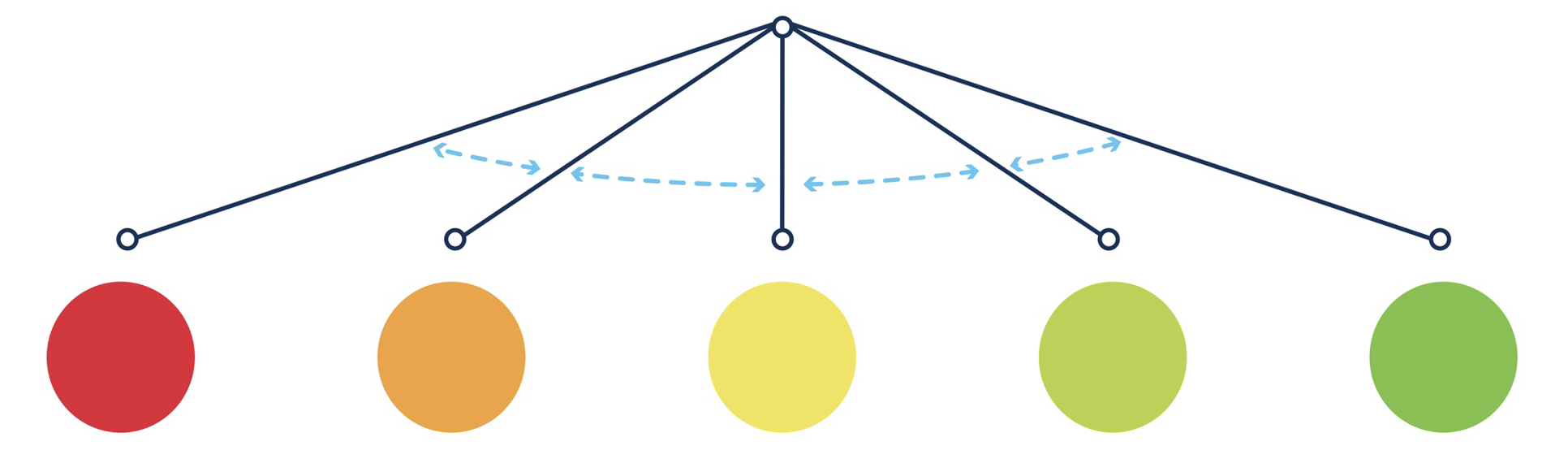
Due to the variability of exposure and degree of inflammation, the treatment needs to be adjusted accordingly. Let me explain with the pendulum of treatment Atopic dermatitis:
• Red Dot:
This would be severe eczema needing topical steroid ointment under wet occlusion at night. In the morning a quality emollient. Second generation antihistamine to stop the scratch-itch-cycle
• Orange Dot:
Topical steroid without the wet occlusion (not longer than 7-10 consecutive days) on all affected areas and the emollient all over at night and the antihistamine. In the morning the emollient.
• Yellow Dot:
Either a calcineurin inhibitor of a PDE4 inhibitor ointment twice a day on all the effected areas and the emollient and the antihistamine.
• Pale Green Dot:
Either a calcineurin inhibitor of a PDE4 inhibitor ointment at night only and the emollient night and day and antihistamine as needed.
• Bright Green Dot:
Use topical steroid or calcineurin inhibitor of a PDE4 inhibitor ointment twice or three times a week on the areas that usually flares and continue twice daily with the emollient.
• In case of exacerbation step up the previous or first step – Let the pendulum swing back!
The same treatment approach would be followed for allergic rhinitis according to allergen exposure – in patients with intermittent allergic rhinitis this could be the pendulum:
• Using saltwater spray/douche and Intranasal steroid spray (INS) twice a day with a second-generation antihistamine.
• INS once a day and the saltwater spray twice a day. Antihistamine once a day
• INS once a day and saltwater spray one a day with antihistamine as needed
• Only the saltwater spray and antihistamine as needed
• Only the saltwater spray as needed
• Let the pendulum swing back if exacerbate
Every patient with an allergy, including Allergic Rhinitis, Allergic conjunctivitis, Asthma, Atopic dermatitis or eczema, anaphylaxis and food and drug allergy need to know how to step up and down the treatment. This will be different in different patients and in the same patient different at different times.
Unless we desensitise or one can totally avoid exposure to an allergen, the reaction will happen always and immediate with exposure to the specific allergen.
Get you own personalised Pendulum treatment plan
Immunotherapy for Allergies and Recurrent Urine tract infection:
Allergen Immunotherapy is the only disease modifying treatment available for Allergic conditions, including allergic rhinitis, asthma, and bee venom allergy. It improves symptoms by reducing disease severity and reduces the need for medications leading to better quality of life. This is being accomplished by inducing tolerance while on the treatment, but also years after the treatment was stopped. For patient with a history of anaphylaxis after a bee sting, this would be lifesaving treatment!
Tolerance induction to a specific allergen happens through modulating the immune response toward the specific allergen. Allergy testing would lead to the identification of the causative allergen. Immunotherapy can be done either by Sublingual spray or subcutaneous injections.
A similar treatment is now also available for patients suffering with recurrent episodes of urine tract infections. Both the innate and adaptive immune systems are being stimulated to prevent future infections caused by the four most common implied bacterial strains. This treatment will improve quality of life for sure and reduce the need for future antibiotic use and protecting against development of antibiotic resistance.
For further information, watch the video clip and contact the Allergy and Asthma clinic for appointments.
Watch the Video
Allergy Hat Talk Series
Living with allergies lead to poor quality of life, not only for the affected person, but often for a whole family. Restrictions on where they live, what foods are available in the house and their freedom on dining at restaurants is the cause of lots of stress in these families.
Food allergies are on the increase worldwide. It unfortunately is still not taken seriously by too many people, especially in the food manufacturing industry. The “Big 8” needs to be mentioned on labels as reading labels and avoiding the food group the patient is allergic too, is all we can offer them.
Read more
Food Allergies – Avoidance or not?
For many years we advised mothers of new-born babies and from an allergic family, to
only start feeding the baby solids at 6 months of age. They were also advised to
avoid allergenic foods like egg, peanut, and fish even up to 9 and 12 months.
New research changed this perception, and we now know that exposing infants
earlier to foods in their diet might be protective. Solids should be introduced at 4
months of age while still breastfeeding, as breast is best! or on formular milk.
Allergenic foods like peanut should be introduced early and mothers need to consult
with a dietician or doctor about this.
Asthma - Reliever Medication
An asthmatic patient usually has a reliever inhaler nearby to use in case of an acute
asthma exacerbation. It used to be short acting ß-agonist that acts fast. The
guidelines changed a year ago due to overwhelming data that showed the danger of
overusing that kind of inhaler too frequently. It is perceived to be safe by the
patients since it is available over the counter.
If you still are following
old ways of short acting ß-agonist usage, please consult with your medical
practitioner to get a new treatment plan. If you need to use any reliever more than
three times a week, your asthma is not controlled, and your controlled treatment
needs to be adjusted. This is a process, just as a Diabetic patient needs to adjust
their treatment regularly.
Allergy Tests – what you see might not be what the Allergist sees!
Allergy testing and the interpretation of these tests have changed over the years as we gain more insight in allergic conditions and the way the immune response reacts to allergens. Many people, especially children, are advised to avoid wheat from their diets due to a seemingly positive blood test or skin prick test for wheat. This might be due to a false positive reaction because the patient is grass allergic. Grass allergy is quite common in our sunny South Africa with long pollen seasons. The proteins that elicit a reaction when allergic to grass, also is present in the test for wheat. We have new levels that we take into consideration when interpreting tests results to avoid confusion. Blood tests to distinguish between cross-reaction of true allergy, is available.